Ultimate Guide to Cap Torque Testing
What is Torque Testing?
Torque testing measures the rotational force required to either apply (lock) or remove (open) a closure from a container. It is a critical offline or online process parameter for production units. The appropriateness of the torque value significantly impacts intermediate transportation and final consumer consumption.
Two Main Testing Modes
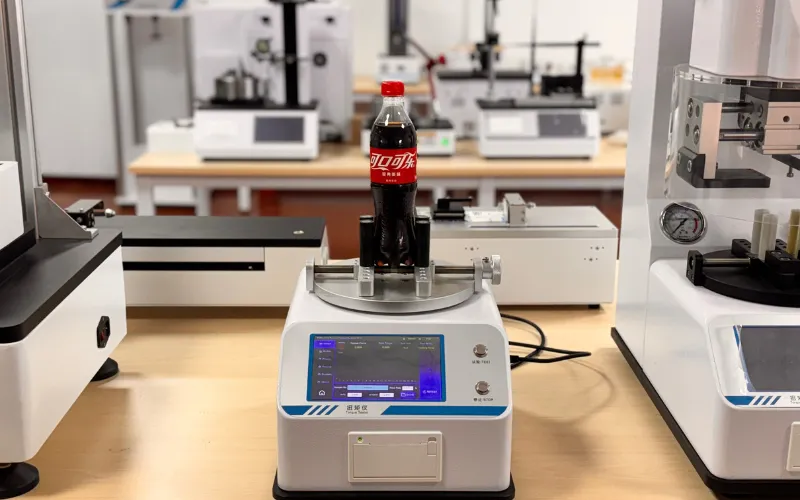
The NLY-20A features a dual-mode design to cover all testing needs:
1. Opening Force (Removal Torque): Measures the peak force required to unscrew the cap. This simulates the consumer's experience. The system automatically holds the peak value to ensure the result is recorded accurately.
2. Locking Force (Application Torque): Measures the force used to seal the cap. This is crucial for setting up capping machines on the production line.
Key Features of the NLY-20A
- Visual Interface: A 7-inch high-definition touch screen allows users to view detection data and results quickly and intuitively.
- High Precision: The system utilizes a micro-computer control with a Class 0.5 accuracy and a resolution of 0.001 N.m.
- Unit Conversion: Users can freely switch between multiple units: N.m, kg.cm, lb.in, N.cm.
- Intelligent Configuration: Features include overload protection, automatic zeroing, and fault prompts to ensure user safety.
Understanding the "Strip Ratio" (Broken Shape Ratio)
In the advanced parameters of the NLY-20A, users can set a "Strip Ratio" (Referenced as 'Broken Shape Ratio'). This helps identify when a cap has been over-tightened to the point where the threads fail or "strip," providing a deeper level of quality analysis beyond just peak force.
Data Management and Standards
The equipment complies with multiple national and international standards, including GB/T 17876, ASTM D2063, ASTM D3198, and ASTM D3474.
For data recording, the NLY-20A comes standard with a micro-printer and USB interface for data export. It also supports professional software for unlimited statistical storage and analysis.
FAQ
Q1. What is the clamping range?
The standard fixture supports diameters from Φ5mm to Φ180mm.
Q2. Can I print the results?
Yes, a micro-printer is included as standard configuration.
Q3. What happens if I overload the sensor?
The system is equipped with intelligent overload protection to prevent damage to the high-precision sensor.